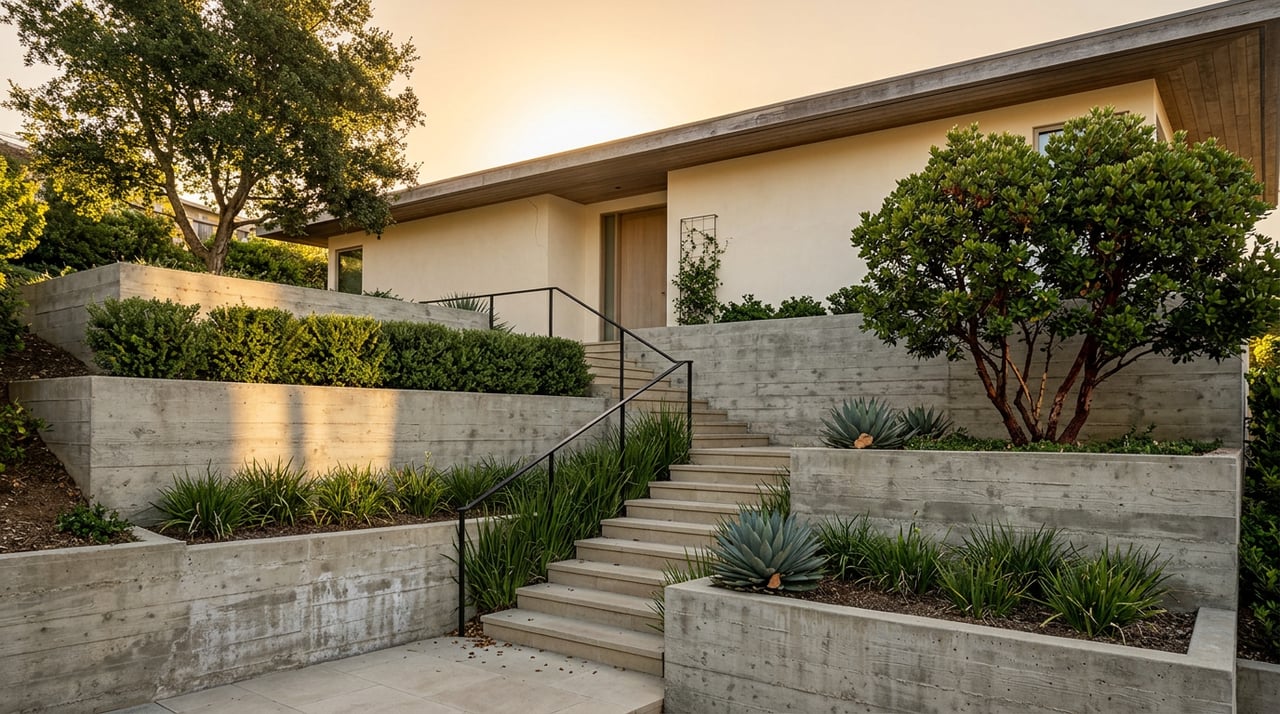
Understanding the Eagle Rock Real Estate Market
Pull up Eagle Rock's numbers from the same source three months apart and you get two stories that don't agree with each other. In March 2026, the median sale price for a home in Eagle Rock was $1.3 million, down 8 percent from the year before, with the typical listing moving in 26 days. By June, the median for all home types in the same neighborhood had jumped to $1,444,497, up 18.6 percent year over year. Nothing about Eagle Rock changed in ninety days. What changed was which homes happened to close.
That gap is the story. A single median price treats Eagle Rock as one market when it is actually three, stitched together by an averaging formula that erases the differences buyers care about most. There's a walk-to-coffee market, a hillside-view market, and a restoration-quality market, and each one prices differently enough that comparing a listing to "the median" tells you almost nothing about whether it's a good deal.
Eagle Rock is compact, a little over three and a half square miles tucked between Glendale, Pasadena and Highland Park, but it packs in distinct micro-neighborhoods that don't behave like one market. There's the flat commercial spine along Colorado Boulevard, the hillside streets rising north toward the Verdugo Mountains, and pockets like Dahlia Heights that trade proximity for seclusion. When a month's closings lean toward one of those pockets, the median swings, even if no individual home changed in value.
Realtor.com's April 2026 snapshot put the median listing price at $1.395 million and the median sold price at $1.275 million, with 62 active listings and homes selling at 103 percent of asking on average, a 51-day median time on market. Zillow's tracked average home value sat at $1,276,756 as of the end of June 2026, up a modest 0.8 percent year over year, a much calmer read than Redfin's 18.6 percent jump measured the same month. Three sources, three different pictures, and all of them accurate for what they're actually measuring. The lesson isn't that one tracker is wrong. It's that "the Eagle Rock market" is really an average of markets that don't move together.
If you want a number that behaves more predictably than the median, look at distance to Colorado Boulevard instead of distance to the freeway. Homes within a ten-minute walk of the boulevard consistently carry a premium of roughly 5 to 10 percent over comparable properties sitting deeper in the hills, and the effect concentrates hardest on the stretch between Eagle Rock Boulevard and Townsend Avenue, the highest-walkability corridor in the neighborhood. Homes within a five-minute walk of that stretch tend to sell fastest and hold their value best when the broader market softens.
That premium isn't paying for square footage or a newer roof. It's paying for the ability to walk to a coffee shop, pick up dinner, or wander into a bookstore without getting in a car, a lifestyle attribute that shows up as harder pricing power precisely because it can't be added after the fact. You can renovate a kitchen. You can't move a house six blocks closer to the boulevard.
North Eagle Rock, the hillside band rising above Colorado Boulevard, trades walkability for a different asset entirely: panoramic views toward downtown, Glendale and the San Gabriel range, along with larger lots that don't exist on the flats. Dahlia Heights pushes further into that trade, offering a more secluded hillside feel at the cost of being a longer walk or drive from the commercial core.
Neither trade-off is objectively better, but conflating them under one median obscures what a buyer is actually purchasing. A hillside home commanding a premium for its lot size and view is answering a different question than a flatland bungalow commanding a premium for its ten-minute walk to a taco counter. Buyers who assume "higher price equals better house" without asking which premium they're paying for end up disappointed either way: the hillside buyer who wanted walkability, or the flatland buyer who wanted a view.
Eagle Rock's median has consistently run higher than neighboring Highland Park's in the same reporting periods, a gap of roughly $150,000 by some comparisons. It's tempting to read that as Eagle Rock being "better" and Highland Park being "cheaper," but the honest read is that the two neighborhoods are selling different things. Highland Park has Gold Line rail access that Eagle Rock lacks entirely, along with a denser, later-closing nightlife corridor on York Boulevard. Eagle Rock's flatland streets tend to run quieter, with fewer through-commuters and more parking availability near the retail core.
Neither pattern makes one neighborhood a better financial decision than the other. It makes them different products serving different daily routines. A buyer comparing the two on price per square foot alone is comparing rail access against a quieter street, which isn't really a price comparison at all.
Even inside Eagle Rock's flatland core, architectural style creates its own pricing bands that a neighborhood-wide median can't capture. Restored Craftsman bungalows, Spanish and Spanish Revival homes from the 1920s and 1930s, and postwar Mid-Century properties each trade in a different range, with price-per-square-foot spreads running from roughly $565 on the low end for a Spanish-style home needing work to as much as $1,200 for a fully restored, premium-street Craftsman. That's a wider spread than the gap between Eagle Rock's flats and its hills. Two homes on the same block can sell at meaningfully different prices depending entirely on how faithfully the original woodwork, tile and massing survived, which is exactly the kind of detail a design-literate presentation can turn into leverage at listing time rather than a discount at negotiation time.
Eagle Rock's larger lots, particularly in the hills and on some of the wider flatland parcels, make it a natural target for buyers running an accessory dwelling unit strategy: buy at the higher end of the range, add a second unit, and let rental income offset the purchase price. The math sounds clean until you check it against actual construction costs. Permitted ADUs can genuinely support resale value and add rental income over time, but build costs run high enough that immediate recoup is modest by national cost-versus-value benchmarks, not the fast payback the pitch implies. An ADU is a long-hold value play in Eagle Rock, not a shortcut that makes an aggressive purchase price pencil out in year one.
Buyers evaluating an investment property here should model the ADU as a multi-year addition to the property's income and resale profile, not as a line item that closes the gap between what a home costs today and what a buyer can comfortably afford.
Is Eagle Rock actually more expensive than Highland Park? On median price, usually yes, though the gap has narrowed and widened depending on the month and the mix of homes selling in each neighborhood. The more useful question is whether you're paying for Eagle Rock's quieter streets and parking or Highland Park's rail access and nightlife.
Does a hillside lot cost more because it's a better investment? It costs more because it's answering a different question than a flatland home. Lot size and view drive the hillside premium. Walkability drives the flatland premium. Neither is inherently the stronger long-term asset; it depends on what the next buyer in that micro-market is looking for.
Will an ADU pay for itself quickly enough to justify stretching my offer? Based on current national cost-versus-value data, not usually in the short term. Treat it as a value-add over a multi-year hold rather than a way to make an aggressive purchase price work today.
If you're weighing a hillside lot against a flatland bungalow, or trying to figure out whether an Eagle Rock listing is priced for its walk score or its view, that's exactly the kind of read the Longfellow + Leach Team does before a client ever writes an offer. Reach out for a complimentary valuation and design plan built around what your specific block, not the neighborhood median, is actually telling us.
Stay up to date on the latest real estate trends.
We're here to help you every step of the way. Reach out today with our experienced team for expert guidance and support.