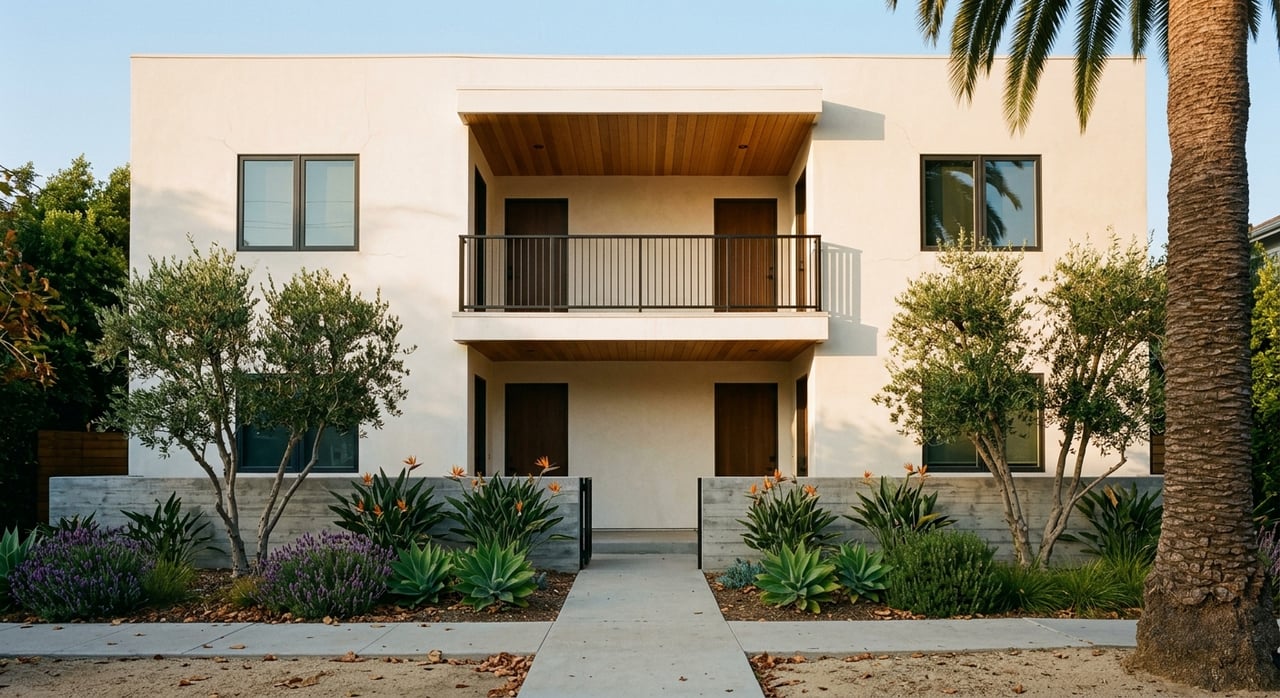
Los Feliz Duplex Investment Strategies for Small Multifamily
If you have been eyeing a Los Feliz duplex or fourplex, you already know this is not a typical numbers-only investment play. In this neighborhood, small multifamily often sits in the same price conversation as single-family homes, which can make the decision feel more nuanced than a standard rental-property search. The good news is that with the right framework, you can evaluate these properties more clearly and spot where income, lifestyle, and future upside may align. Let’s dive in.
Los Feliz is a premium, low-turnover market, and that shapes how duplexes and fourplexes trade. As of February 28, 2026, Zillow reported an average home value in 90027 of $1,751,694 and a median list price of $2,348,167, with just 72 homes for sale and 12 new listings, highlighting the neighborhood’s scarcity. At the same time, average asking rent was about $2,518, according to Zillow’s 90027 market data.
That contrast matters. In Los Feliz, a duplex or fourplex is often less about chasing outsized cash flow and more about using rental income to offset ownership costs while preserving long-term flexibility. For many buyers, the appeal is the combination of location, limited supply, and the ability to create value over time.
A Los Feliz duplex or fourplex usually works best as a hybrid investment. You are not just buying a rent roll. You are also buying into a highly sought-after central Los Angeles location where scarcity and optionality can influence value.
In broader context, Zillow shows the Los Angeles-Long Beach-Anaheim metro with an average home value of $954,296 and average rent of $2,884, which underscores how expensive Los Feliz is relative to the wider market. That is one reason your underwriting needs to be disciplined. Rent helps, but the purchase price still demands careful analysis.
For many buyers, especially owner-users, the key question is not, “Will this property throw off huge cash flow on day one?” It is, “How much does the second, third, or fourth unit reduce my effective housing cost?”
That distinction is important in Los Feliz. If you compare a duplex to a single-family home at a similar price point, even moderate rental income can materially improve affordability. In that sense, the deal may pencil because of income offset and future flexibility, not because of unusually high initial yield.
According to the CBRE U.S. Cap Rate Survey H2 2025, Los Angeles infill multifamily was generally trading around 4.75% to 5.5% for stabilized Class A and 5.25% to 5.75% for value-add Class A. For Los Feliz small multifamily, that points to a practical underwriting range in the low- to mid-5% cap-rate band, with results varying based on condition, vacancy, and legal status.
That means you should be cautious about stretching on assumptions. If the rent roll is weak, the unit mix is inefficient, or the property has unresolved legal or permit questions, the numbers can get tight quickly.
The rental story in Los Feliz is steadier than explosive. Zillow’s 90027 data showed year-over-year asking-rent growth of 1.8% as of February 28, 2026. That is healthy, but it does not support an aggressive pro forma built on sharp future rent jumps.
Instead, your focus should shift to the property itself. Unit mix, condition, parking, and legally permitted improvements can affect income far more than neighborhood averages alone.
According to Zillow’s 90027 rent trends, asking rents were averaging about:
These numbers are useful for rough planning, but they are not interchangeable. A bright, updated unit with strong layout and parking can perform differently from an older unit with deferred maintenance. In Los Feliz, details matter.
Leasing fundamentals across Los Angeles multifamily remain relatively tight. CBRE’s Los Angeles Multifamily Figures for Q1 2025 reported 95.4% occupancy and an average rent per unit of $2,822. That does not guarantee performance for every property, but it does support the case that well-located small multifamily in central Los Angeles can continue to lease steadily.
For an investor, that is encouraging. For an owner-user, it adds confidence that the extra unit or units may provide dependable offset income if priced and maintained well.
A clearer way to analyze duplexes and fourplexes is to break them into three distinct strategies.
This is the simplest model. You underwrite the property based on current or near-current income, assume modest rent growth, and compare the resulting cap rate to broader Los Angeles infill benchmarks.
This framework works best when the building is already leased near market and there is limited room for improvement without significant turnover or approvals. It is often the right approach for buyers who prioritize predictable performance over repositioning.
A value-add acquisition depends on improving rents through permitted renovation, better operations, or lawful additions such as an ADU. In Los Feliz, this can be compelling, but only if you verify what is legally possible before you buy.
Even small rent changes can matter. Using the current 90027 rent framework, increasing one one-bedroom from $2,150 to $2,500 adds $4,200 in annual gross rent. When cap rates are in the low-5% range, modest NOI gains can translate into meaningful value creation.
For many Los Feliz buyers, this is the most practical framework. You live in one unit and treat the remaining unit or units as an offset to your monthly housing cost.
This approach can make a high-cost neighborhood more accessible. It also gives you flexibility over time, but you still need to understand local and state rental rules before you assume too much freedom in how the property can be operated.
In Los Angeles, regulation is not a side issue. It is central to your investment thesis.
The Los Angeles Housing Department says the city’s Rent Stabilization Ordinance generally applies to rental properties built on or before October 1, 1978. LAHD also notes that coverage can include duplexes, ADUs, JADUs, and two or more single-family dwelling units on the same parcel, and that a property’s status can change when it is renovated, demolished, or expanded.
Under state law, the rules can look different. The California Courts self-help guidance explains that the Tenant Protection Act generally does not apply to a duplex where the owner lives in the other unit.
But that is not the same as an exemption from city rules. If a property is otherwise covered by Los Angeles RSO, owner occupancy does not automatically remove those local requirements. That is why legal due diligence matters just as much as financial due diligence.
In a neighborhood like Los Feliz, upside often comes from legal density rather than dramatic rent growth alone. Cosmetic upgrades can help, but zoning and entitlement potential may have a bigger long-term impact.
The California Department of Housing and Community Development says ADUs and JADUs are allowed under state law and may be detached, attached, or created from existing space. Los Angeles City Planning has also noted that SB 9 can streamline two-unit development and lot splits in single-family zones, potentially allowing up to four units on lot area traditionally used for one home.
Not every lot offers the same path. Los Angeles City Planning’s ZIMAS tool provides parcel-specific zoning, land use, permit history, and overlay information.
That is especially important if a property falls within an HPOZ or another overlay that may affect exterior work, additions, landscaping, or new construction. If your renovation or expansion plan ignores those constraints, your timeline and costs may look very different from your initial pro forma.
Here is one useful example from current 90027 rent data. If a fourplex includes two one-bedroom units at $2,150 each and two two-bedroom units at $3,250 each, that produces $10,800 per month in gross scheduled rent, or $129,600 per year.
If you model operating expenses at 40%, NOI comes to roughly $77,760 annually. Applying a 5.25% to 5.75% cap rate implies a value of about $1.35 million to $1.48 million. This is not a comp, but it is a helpful reminder that many Los Feliz small multifamily deals need strong rents, legal added density, or a scarcity premium to support higher pricing.
The best duplex and fourplex opportunities in Los Feliz are often not the flashiest properties. They are the ones where the legal status is clear, the leasing assumptions are realistic, and the physical asset offers room for thoughtful, lawful improvement.
That might mean a clean owner-user duplex with one strong offset unit. It might mean a fourplex with under-market interiors and a sensible renovation path. Or it might mean a property where zoning and parcel characteristics create ADU or density potential worth exploring in detail.
A design-forward eye can also matter here. Smart upgrades, better layouts, and careful presentation can influence tenant demand and future resale appeal, especially in a neighborhood where architecture and setting carry real weight.
If you are considering investing in Los Feliz duplexes and fourplexes, it helps to evaluate each opportunity through a focused checklist:
In Los Feliz, the right small multifamily purchase can offer more than one kind of return. You may gain income, flexibility, and long-term optionality in one of Los Angeles’ most supply-constrained neighborhoods.
If you want a measured, hyperlocal read on a Los Feliz duplex or fourplex, the Longfellow + Leach Team can help you evaluate the property through both an investor lens and a design-minded neighborhood lens.
Stay up to date on the latest real estate trends.
We're here to help you every step of the way. Reach out today with our experienced team for expert guidance and support.